There is a fundamental problem when it comes to maths communication. In other areas of study, it is possible for a researcher to (somewhat) succinctly describe their field. Even more, it might be possible for a non-expert to read a paper in these fields and get a gist – though perhaps incorrectly – of what it is about. This is a sharply double-edged sword; the field can seem more accessible, and more people take an interest to it, but there is a danger of non-experts assuming they understand a concept entirely when they are missing many crucial details. They are in the worst position of knowledge: they don’t know what they don’t know. This has become particularly dangerous in medicine and climate science, where a number of people seem to be more confident in their assertions than the people who dedicate their entire lives to studying it.
This isn’t the case for maths. Some may claim this is because maths is ‘too hard’ and that mathematicians are unrelatable geniuses who we can never hope to understand. I strongly disagree. The issue is fairly straightforward: maths is written in a different language. If medical papers were all written in hieroglyphics, it too would be considered a subject that only few could ever understand. Of course, all areas of research have their own jargon. But it’s easier to make a guess at what gastro-oesophageal junction means than
And that brings me to this series: the mathematical alphabet. Here I will introduce various mathematical symbols, their history, meaning and use in current research. I hope this can be just as engaging to those who have encountered them before as to those who are seeing them for the first time.
First up is a symbol so commonplace that my entire research field could not exist without it. And yet its invention was so controversial that its name was originally used to mock and disregard it. It is of course , the imaginary number.
Imaginary numbers first came about through attempts to find a formula for the solutions of cubic equations. There are plenty of articles and videos that detail the feud between Tartaglia and Cardano – two 16th Century Italian mathematicians – over these equations. I am not going to rehash this passionate quarrel (but I do recommend Veritasium’s great video on the subject); instead I want to explain exactly what these numbers are and, more importantly, discuss my favourite consequence of their existence: the complex plane.
What is ? It is the square root of . And by extension we can write the square root of any negative number using this symbol:
and so on…
The name imaginary may be fitting in that these numbers are not something we can use to count everyday objects. You won’t wake up on Christmas morning to find presents under the tree. But by that analogy, negative numbers should be called imaginary too. I personally have never bought a packet of crisps with crisps inside. And even more so, if we consider irrational numbers such as , I have never found a … leaf clover. So, if we are happy to say that negative numbers and irrational numbers exist, then we should also welcome imaginary numbers with open arms, despite the unfortunate name. And what a better way to welcome these imaginary numbers into our mathematical language than to add them to the number line. But how exactly is that possible?
The number line extends from to . On it is marked the integers, between them the rational numbers, and between them an uncountably infinite number of irrationals. There is simply no space for any more numbers. Except we don’t live in a one-dimensional world; we have the privilege of being able to go up. And so, the imaginary numbers form their own vertical line, and together the real and imaginary numbers form the complex plane. A two-dimensional world of numbers with endless possibilities. And as a two-dimensional world, we can describe it in more than one way. Yes, we have the x-axis (reals) and y-axis (imaginaries), but we could also think of a complex number as a vector with some length and angle.
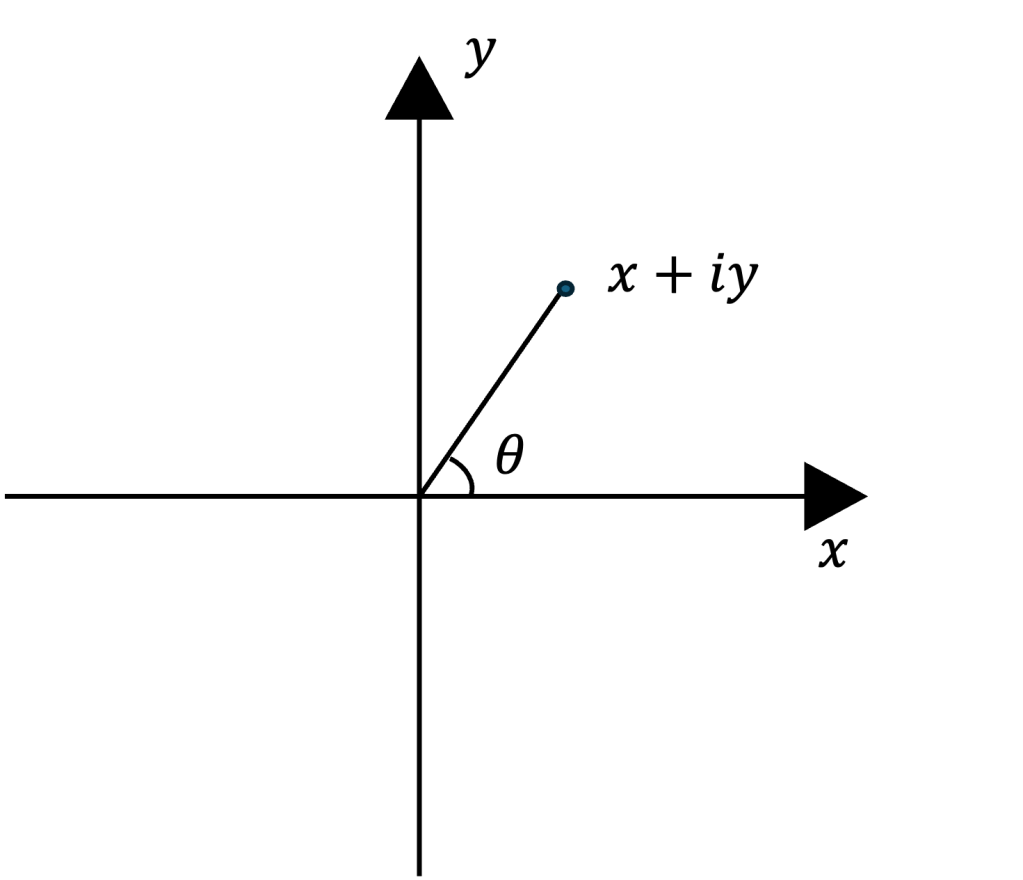
Let’s take the complex number . In our complex plane it has x-y coordinates . But the point can also be described by its distance from the origin, , and its angle from the horizontal, . Then here comes the magic; our number, , can be written in two ways:
This is a result of Euler’s formula, which reveals that is a complex number who’s distance from the origin is , and who’s angle from the horizontal is . It is difficult to convey how important this fact is: in mathematics, optics, quantum physics, even electrical engineering. And on a personal note – my own research would be impossible without it. You may recognise the special case of this formula
,
a consequence of being degrees – which is radians – away from its positive counterpart.
The real fun starts when we rotate our angle all the way round the complex plane. You may recall that the angle represents the same as the angle 0. As do , and so on… So we can write
Ok, it is odd, but perhaps reasonable. Until you remember that logs exist. A log acts as the inverse of the exponential. Let’s apply it to this equation:
Which evaluates to:
In the words of Scooby Doo: “Ruh Roh”. These numbers may represent the same angle, but they are definitely not numerically equivalent. By extending it to the complex plane, our logarithm has become an almighty multi-valued function. I don’t know if you’ve spoken to a mathematician lately, but they’re generally not a fan of this. If a mathematician and a logarithm had a conversation it might go something like this:
Mathematician: Hi Logarithm. Here’s the number . Give me something back.
Logarithm: Sure thing! .
Mathematician: Ok, nice!
Logarithm:
Mathematician: What?
Logarithm:
Mathematician: Stop that.
Logarithm:
Mathematician: Seriously, this is not what functions are supposed to do.
Logarithm: …
Mathematician: …
Logarithm:
Mathematician: Get out of my sight.
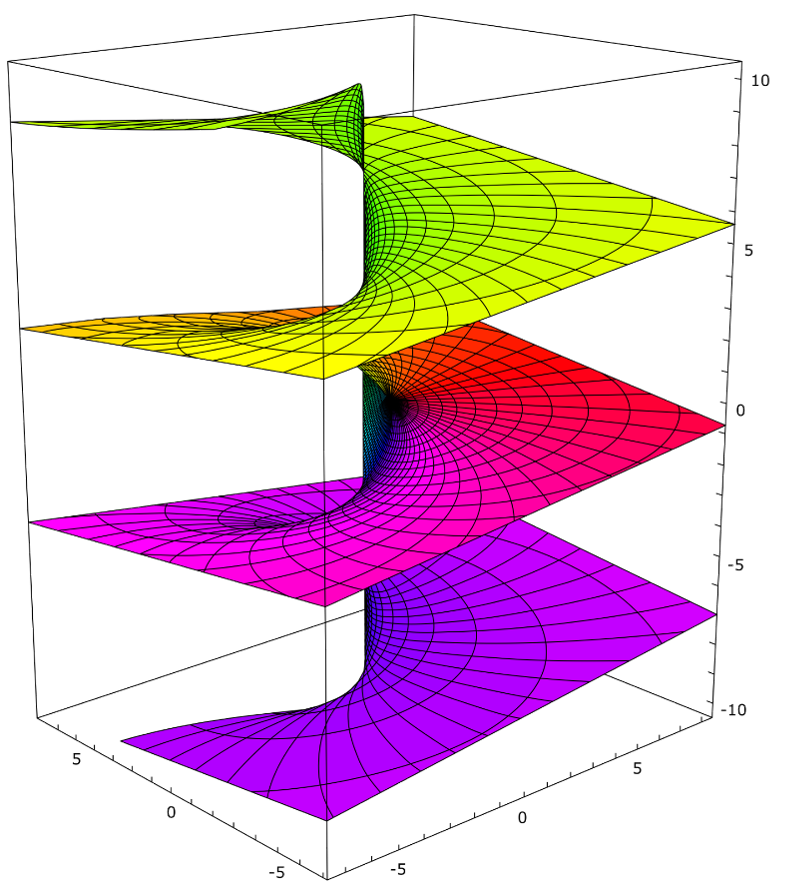
But don’t worry, here comes our knight in shining armour: Bernhard Riemann. Riemann was the ultimate romantic. He didn’t ask Mr. Logarithm to change. No, he decided that the world should change around the logarithm. Instead of asking the logarithm to be single-valued, he conjured up a new complex plane that allowed the logarithm to be single valued, without having to change a thing. Imagine a point on the complex plane. Our previous issue arose because we dragged that point all the way round the plane back to its starting place. The log at the start and end point differ. Riemann replaced our boring old complex plane, with a helix-like structure, where every rotation of degrees (or radians) takes us to a new point, that is above the starting point. Hence, every point on this plane has a single value associated with the logarithm.
There are many other multi-valued functions out there, each with uniquely beautiful Riemann surfaces. One of these is even the humble square root. And this is only one consequence of opening your mind up to a two-dimensional space of complex numbers. As it turns out, imaginary numbers were not some fanciful yet useless idea; they actually unlocked a whole new world of mathematics, with a vast number of applications. Not too bad for something that ‘isn’t real’.
 Letters and Words
Leave a comment